Essay 003

On Explaining Myself

By Francesco · 1 min read

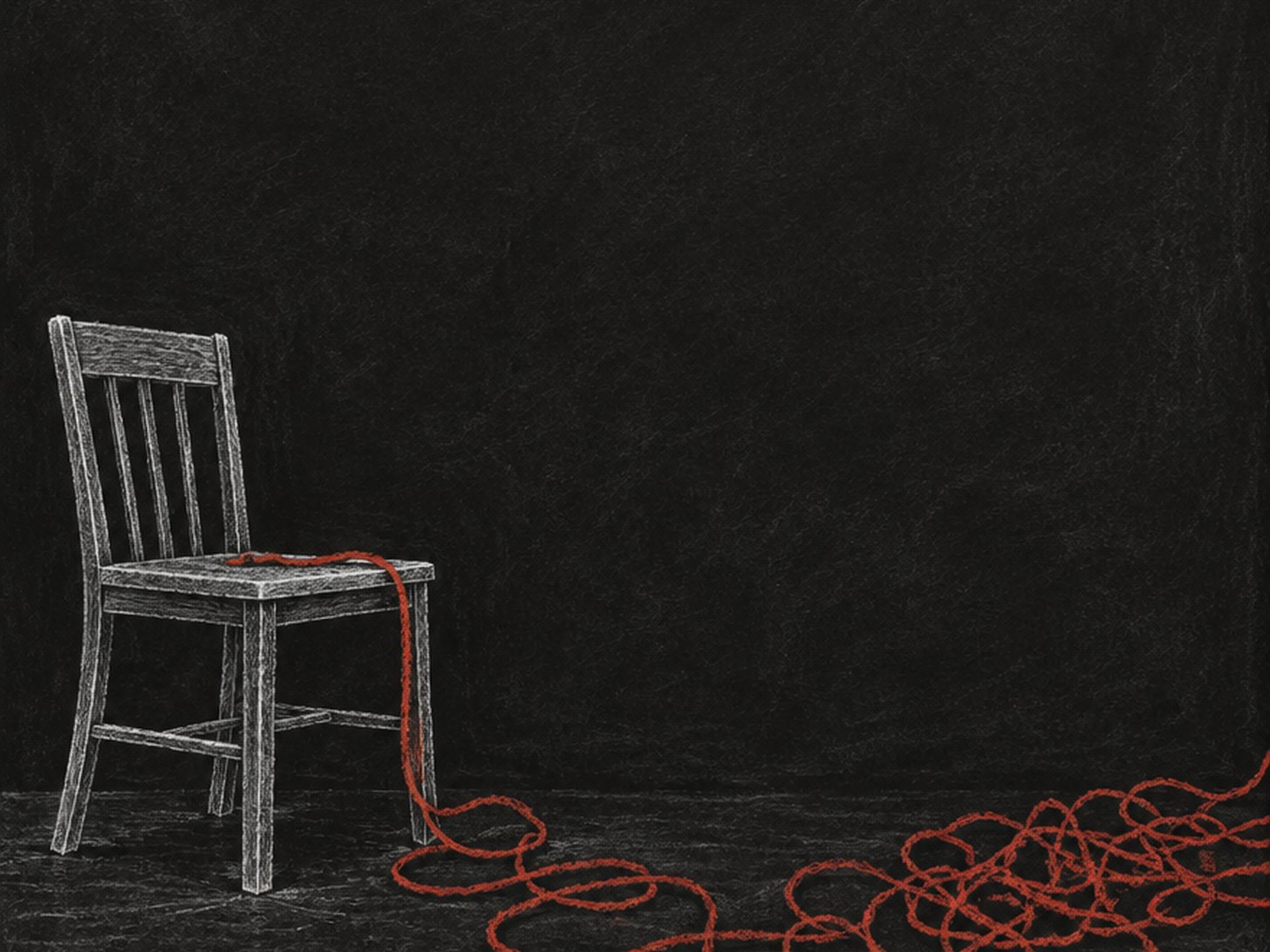
Chalk drawing: an empty chair, one long red line spilling off the seat and tangling across the floor.

It can feel like a truck drove over you. A sentence, a statement, or a question reached you, and the last thing you remember is telling yourself, "Hold on, that's not what happened. That's not who I am."

"In reality, something else happened. What I did means something else."

I could go on and on.

I sometimes do.
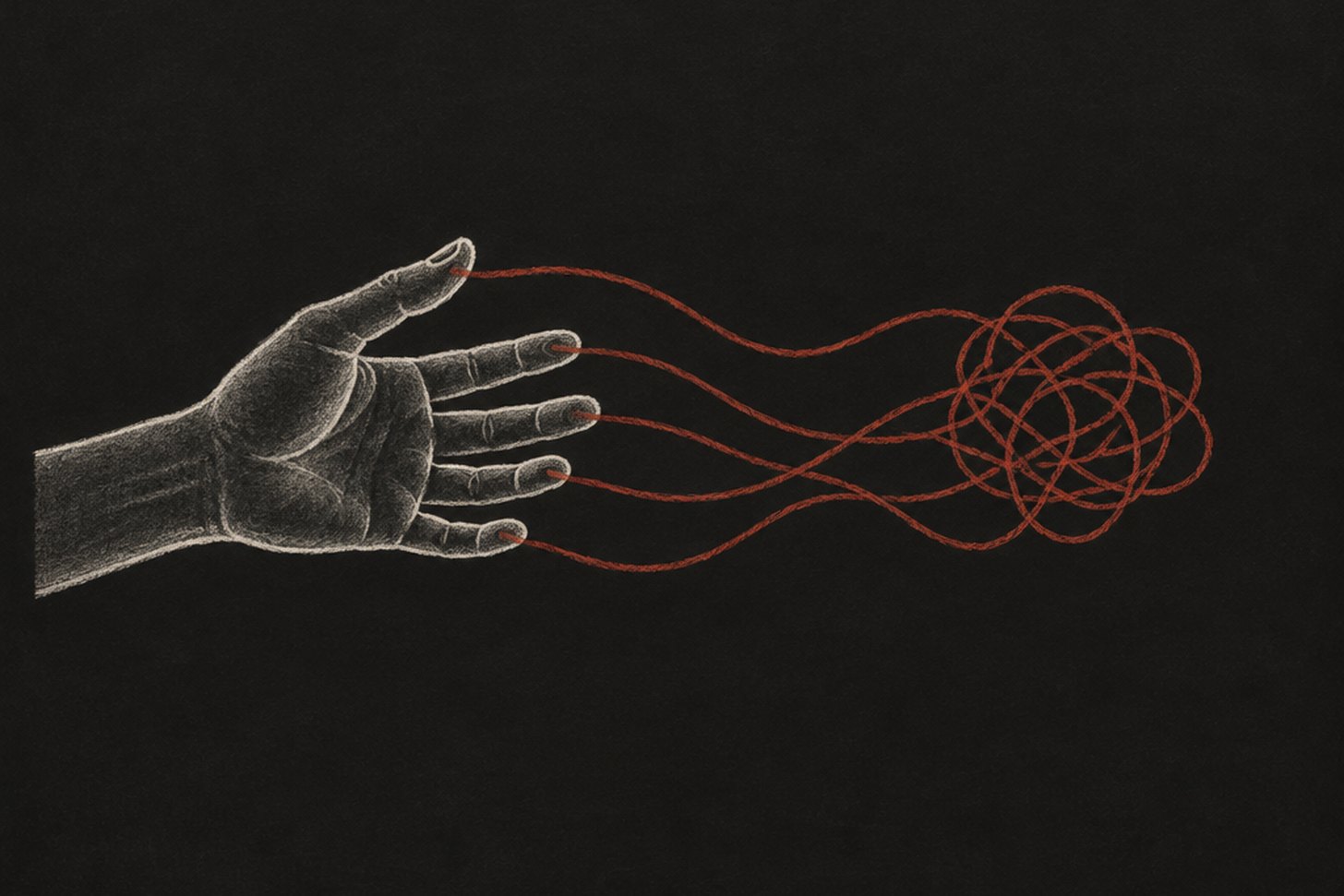
Chalk drawing: an open hand with tangled red lines unspooling from the fingertips.

If I don't explain, the last message the universe hears is one I don't believe in, one that isn't true. Because if it were true, I would do anything in my power not to be that person.

I explain my reality not to change what happened, but to ease a hurt that comes from how I expected things to be.

The explaining feels soothing. It isn’t.

I think of what to say. My face heats up. My stomach clenches; I hold my breath and speak again.

When I notice I'm explaining myself to no avail, I stop.

I notice. I feel the discomfort. I breathe through it. My body knows what's true.
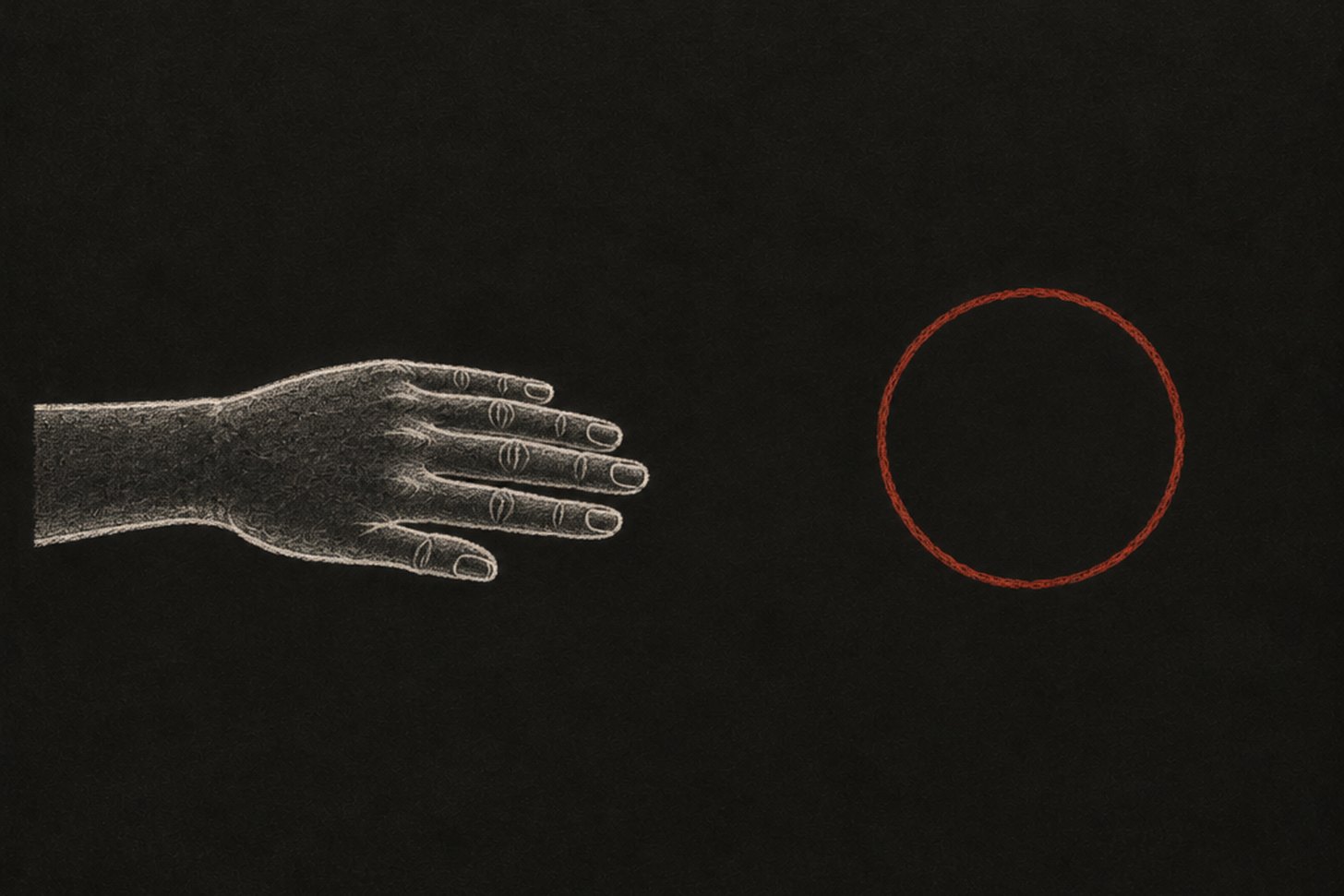
Chalk drawing: the same hand resting still beside one slow red circle.

Staying gets easier the more often I do it. Staying here allows me to stay somewhere else too.
Chalk drawing: two short red strokes with an empty space between them.

Notice before reacting. That's the gap.

Also on Substack

· · ·

Sources and further reading

Where this comes from

None of this is new. People have been writing about this moment for thousands of years, in very different traditions. Here is some of what they said, in their own words where we could find them, and where to read more.

Ancient and spiritual traditions

  • Taoism

    Laozi

    Tao Te Ching, chapter 22

    “He is free from self-display, and therefore he shines; from self-assertion, and therefore he is distinguished.”

    Over 2,000 years ago, the Taoist ideal was a person who does not need to argue for who they are.

    James Legge translation, 1891

    Read the full textOverview: Stanford Encyclopedia

  • Stoicism

    Epictetus

    Enchiridion, chapter 5

    “Men are disturbed not by things, but by the views which they take of things.”

    The Stoics noticed that most of the hurt sits in the picture we had of how things should go.

    T. W. Higginson translation

    Read chapter 5Overview: Stanford Encyclopedia

  • Buddhism

    The Buddha

    Sallatha Sutta: The Arrow (SN 36.6)

    Pain is the first arrow. The sorrow and distress we pile on top of it is a second arrow, and that one we shoot ourselves.

    Thanissaro Bhikkhu translation

    Read the sutta

  • Hinduism

    Bhagavad Gita

    Chapter 2, verse 14

    Krishna tells Arjuna that heat and cold, pleasure and pain, come from contact with the senses. They come and go. Bear them.

    Several translations side by side

    Read verse 2.14

  • Christianity

    Letter of James

    James 1:19

    “swift to hear, slow to speak, slow to wrath”

    Early Christian advice for the moment you want to answer straight away.

    King James Version

    Read James 1

  • Judaism

    Ben Zoma

    Pirkei Avot 4:1

    “Who is mighty? He who subdues his inclination”

    In the Mishnah, strength means mastering your own impulse, not winning the argument.

    Ethics of the Fathers

    Read 4:1 with commentaryAbout Pirkei Avot

  • Islam

    Sahih al-Bukhari 6114

    A saying of the Prophet Muhammad

    “controls himself while in anger”

    The hadith says the strong one is not the one who overcomes people by strength, but the one who controls himself while in anger.

    Muhsin Khan translation

    Read the hadith

  • Anthroposophy

    Rudolf Steiner

    The six basic exercises: equanimity

    “The student endeavors to retain his composure in the face of joy and sorrow”

    The founder of anthroposophy gave six exercises for building character. The sixth is inner balance: feeling fully without being thrown from one extreme to the other.

    Rudolf Steiner Archive

    Read the six exercisesWhat is anthroposophy?

  • Theosophy

    H. P. Blavatsky

    The Voice of the Silence, Fragment I

    “The Mind is the great Slayer of the Real.”

    In theosophy, the busy, story-making mind can hide what is true. The practice is to notice it instead of following it.

    1889

    Read Fragment IAbout the book

  • Greek philosophy

    Aristotle

    Nicomachean Ethics, Book II

    “we become just by doing just acts, temperate by doing temperate acts, brave by doing brave acts.”

    Character is built by practice. You become what you repeat.

    Ross translation

    Read Book IIOverview: Stanford Encyclopedia

Modern research

  • Modern research

    Lieberman and colleagues, 2007

    Putting feelings into words

    In a brain-imaging study, naming the feeling in an upsetting picture lowered the response of the amygdala, a region involved in emotional reactions, compared with other ways of looking at the same picture.

    Psychological Science 18(5), 421 to 428

    Abstract on PubMed

  • Modern research

    Lally and colleagues, 2010

    How are habits formed

    96 volunteers repeated one daily behaviour in the same setting for 12 weeks. It became more automatic with repetition. The average time to level off was 66 days, with a range of 18 to 254. Missing a single day did not materially change the process.

    European Journal of Social Psychology 40(6), 998 to 1009

    Read the paper (open copy)Publisher page

A quote we did not use

  • Correction

    “Between stimulus and response there is a space”

    Often credited to Viktor Frankl

    It sounds like this essay, and it is shared everywhere under Frankl’s name. The Viktor Frankl Institute lists it as an alleged quote: it does not appear in his books. Quote Investigator traces the closest known source to the psychologist Rollo May, writing in 1963.

    Viktor Frankl InstituteQuote Investigator

Essays from the gap between knowing and doing.

Unsubscribe any time.